
Mediterranes Ökosystem
Kultur- und Naturlandschaften der Griechischen Insel Tinos
Availability
- Author
- Hasso Hohmann
- Year
- 2012
- Edition
- hardcover
- Pages
- 272
- ISBN
- 978-3-901519-28-4
- Price
- € 22,00
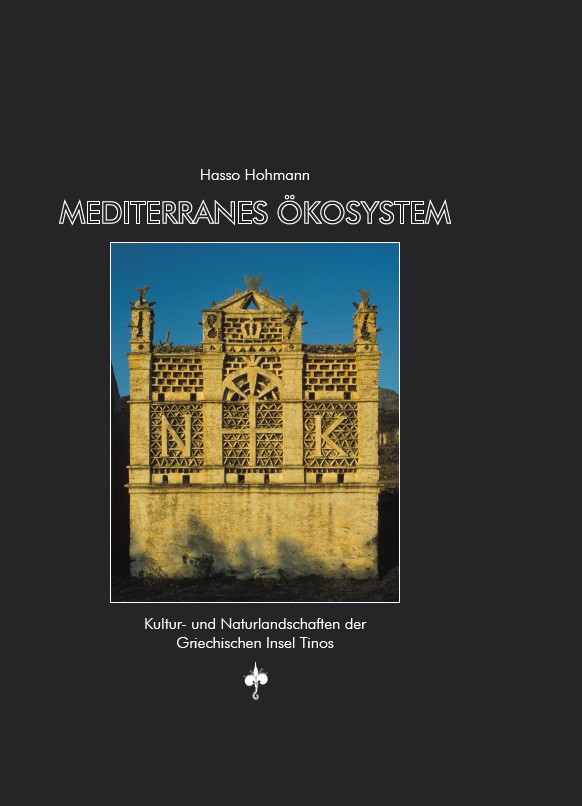
The Cycladic island of Tinos is known for countless, splendidly designed dovecotes and is at the same time the holy island of the Greek Orthodox Church. The publication attempts to depict the island’s historical ecosystem. Buildings and architectural details are examined using an architectural‑ethnological approach.
Of particular interest are the many two-aisled churches, which are connected with the approximately half Roman Catholic population. Almost all of these sacred buildings were erected using corbelled vaults, which were also used for houses, wind and water mills, spring catchments, fountain, wash and water houses, stables and boathouses. In construction terms, the island is archaic. But there are also still quite peculiar wooden trap locks for doors and beekeeping in amphorae.
It was possible to sketch an architectural development that often goes back to external influences. Thus the Ottomans brought the dovecotes to the island—although this is hotly disputed—and many stable buildings must go back to several extremely cold winters in the past.
Examples of almost all building types are reproduced in photos and to-scale plans and are discussed in terms of function and construction. Space is given to the island’s cultural and natural landscapes. The work is a contemporary document of a cultural economy that is now also doomed to decline on Tinos, which, in the shadow of Mykonos and with a slight delay, is losing its particularities through modern ways of life and new commercial framework conditions.
Of particular interest are the many two-aisled churches, which are connected with the approximately half Roman Catholic population. Almost all of these sacred buildings were erected using corbelled vaults, which were also used for houses, wind and water mills, spring catchments, fountain, wash and water houses, stables and boathouses. In construction terms, the island is archaic. But there are also still quite peculiar wooden trap locks for doors and beekeeping in amphorae.
It was possible to sketch an architectural development that often goes back to external influences. Thus the Ottomans brought the dovecotes to the island—although this is hotly disputed—and many stable buildings must go back to several extremely cold winters in the past.
Examples of almost all building types are reproduced in photos and to-scale plans and are discussed in terms of function and construction. Space is given to the island’s cultural and natural landscapes. The work is a contemporary document of a cultural economy that is now also doomed to decline on Tinos, which, in the shadow of Mykonos and with a slight delay, is losing its particularities through modern ways of life and new commercial framework conditions.
Hardcover, 272 pages, thread-sewn, 191 color, 16 black-and-white photos, 112 mostly to-scale architectural drawings, 2 maps, German text, German, English and Greek summary.
Order directly from the publisher